Showing posts with label Postmodernism. Show all posts

Wednesday, December 12, 2012

A Christian Worldview


Anthony Selvaggio has written an interesting book on the modern-day effects of worldliness on the Christian. He does not just address outward behavior but speaks to the internal working worldliness has upon the heart. This I found unique. The short description in the foreword of the book I think sums it up best when he says: “While external behavior practices do matter, the real battle to avoid worldliness occurs internally, in our hearts and minds. While we have been consumed with external matters, worldliness has gained a foothold in our thought processes. Satan has been very successful in getting us to think like the world. This book is an effort to counter Satan’s attack on our minds. It’s a counterinsurgency aimed at thwarting the evil intentions of our adversary.”


The book outlines 7 toxic ideas and then addresses these concerns with scripture. The chapters I found most helpful and interesting were those that dealt with Consumerism and new Technology and it’s effect on our culture, the Christian and the church. Those who would most benefit from this book would be those 35 and under. He does a thorough examination of the 7 ideas he presents and how these ideas are opposite to a Christian worldview and explains why these toxic ideas are non-christian. A good short read.


Anthony T Selvaggio currently serves as a visiting professor of Biblical Studies at the Reformed Presbyterian Theological Seminary in Pittsburgh, PA and is also Theologian in Residence at the Rochester Reformed Presbyterian Church in Rochester NY.


Publisher: P & R Publishing
Publication Date: 2011
ISBN: 1596381965
ISBN-13: 9781596381964


I received my copy from PFO Ministries. To order visit their website.
P.O. Box 26062 • Saint Louis, MO 63136-0062

Another Book Review of this book can be seen at : Ligonier Ministrieshttp://www.ligonier.org/blog/7-toxic-ideas-polluting-your-mind/

Tuesday, November 27, 2012

New Evangelicalism


New Evangelicalism and the Purpose Driven 
and Emergent Movement

In this book you will discover and learn that there has been an intentional departure from believing the Bible is Inerrant and trustworthy, and has plunged the church of the 21st century down the treacherous slippery slope of accommodation and compromise. Paul Smith carefully documents the sobering truth in this book.

Some of the questions that will be answered are:
Are there clear historical markers that identify this paradigm shift?

Why have so many evangelicals identified themselves as “new evangelicals”?

What is the relationship between Fuller Seminary, the Purpose Driven Church, and the Emergent Church Movement?

How is the Emergent Church push for globalization harmonizing with the new world order in these prophetic last days?

Paul Smith answers these questions with case studies and documentation of the events that lead up to where we are now. The author shows the progression of ideas that were birthed in aberrant church beliefs and it’s historical origin. Smith writes that New evangelicals learned about the word “dialectic” from Karl Barth and neo-orthodoxy, and is today used by Emergent churchmen. This decline was only possible when the inerrancy of the Bible, it’s absolute truth was no longer believed by church and influential seminary leaders.
 
 
We must not forget that the church rests on the twin sufficiency of : the inerrant word of God - the Bible and the work and ministry of the Holy Spirit. We must stand firm always on these truths. Every word of God is pure; He is a shield to those who put their trust in Him. Proverbs 30:5 and 2 Timothy 3:16,17 All Scripture is given by inspiration of God, and is profitable for doctrine, for reproof, for correction, for instruction in righteousness, that the man of God may be complete, thoroughly equipped for every good work.


Publisher: Calvary Publishing
ISBN-10: 1597519774
ISBN-13: 978-1597519779
You can also order this book from: Olive Tree Ministries: www.olivetreeviews.org
See a review by Gary Gilley:  http://www.svchapel.org/resources/book-reviews/6-church-history/727-new-evangelicalism-by-paul-smith-costa-mesa-calvary-publishing-2011-215-pp-paper-1200

Wednesday, November 14, 2012

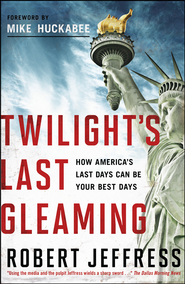
Twilight's Last Gleaming


Economic chaos, immorality, cultural decay, terrorism and global upheaval have convinced many that we are living in the twilight days of America. Dr. Robert Jeffress agrees, but he is quick to add a note of hope and challenge to be salt and light as God‘s children in this world. Twilight’s Last Gleaming makes the case that although we cannot prevent America’s eventual demise, we can delay it…and make a difference for eternity at the same time.

“So that you will prove yourselves to be blameless and innocent, children of God above reproach in the midst of a crooked and perverse generation, among whom you appear as light in the world, holding fast the word of life, so that in the day of Christ I will have reason to glory because I did not run in vain nor toil in vain.” Phil 2:15,16

 
Publisher: Worthy Publishing
ISBN: 1936034581
ISBN-13: 9781936034581

Friday, September 2, 2011

A Theological Look at Emergent and Emerging

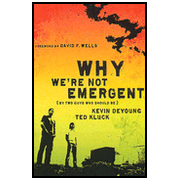
Why We're Not Emergent
One of the benefits in reading this book was the authors took the time to quote large portions of this movement’s leaders such as (Rob Bell, Dan Kimball, Tony Jones, Spencer Burke, Brian McLaren, and several others) and their writings to fully explain what emergent/emerging is, in this way, it gives the reader a more balanced and fair look at the movement being critiqued by DeYoung and Kluck.


In laying out the problems theologically, DeYoung and Kluck make 3 excellent observations in Chapter 1 - Is God Knowable?: 1) the authors state that Emergents question whether we can have any real accurate knowledge about God to begin with. They write emergent leaders are allowing the immensity of God to be swallow up His knowability, and say; “The first problem with the emergent view of journey is that it undermines the know ability of God (pg 35)    2). “With the emergent view of journey is that it suffers from an confusion of categories,” and also makes the well observed point, that “Emerging leaders equate uncertainty with humility. (excellent refutation by the authors is made on this emergent/emerging position). (pg.39)   3). “the third problem with the emergent view of journey is that it establishes doubt as the essence of faith.” (pg.49) Both emerging and emergent seem to have a lack of confidence in the Scriptures.

Our foundation as protestants since the reformation has always been on the Bible being foundational, from which is built upon first Christ (1 Cor. 3:11, and the apostles and prophets writings from the Bible, the non-repeatable foundation of the apostles and prophets that have been preserved for all times in Scripture. (the Bible) is the foundation for truth for the church. (pg.82)  This is what every Christian should, and what devoted followers of Christ do stand firm on.
 
 
The authors do an in-depth observation at who and what the emergent and emerging leaders are writing on blogs and putting in print in order to understand the movement. (pg 23). They have identified who the main emergent leaders are, and those who’s voices are highlighted as bringing forth what aligns with (some) of the views in the emerging conversation. If you can get through some of the heavy reading and philosophical bickering, this book could offer some key insight on what the emergent and emerging church actually is, and why there are many problems with it theologically. Keep standing firm on the truth revealed in Scripture.

Copyright © 2008
Publisher - Moody Publisher
ISBN: 10: 0-8024-5834-3
Reading Review Date: January 2010

Wednesday, August 31, 2011

This little church went to Market

This little church went to Market

In an effort to draw sellout crowds, is the modern Church in danger of selling out? This is the question author and pastor Gary E. Gilley addresses in This Little Church Went to Market. This book is a call for the Church to return to it’s Biblical roots.


This book which was released in 2002 is the 1st book in a series. It addresses the Church Growth Movement and Seeker-Sensitive, purpose-driven church movement which has become popular. At that time, as even is today, the church that has bought into these movements has lost their way from the Biblical model and principles found in Scripture and needs to return to a healthy church which is built upon the essential Christian doctrines of the Faith. This author outlines the current church movements, their history, beliefs, and the infiltration of Psychology into America’s churches. A worldly market-driven philosophy is a key element in promoting this movement. Postmodernism has become an inevitable consequence as well. Polls have become the determiners of success and What works becomes a driving force, and Image becomes everything in drawing unbelievers into the church.

On (pg. 23) the author writes; “Growing churches are creating an atmosphere, an environment of fun. So fun has replaced holiness as the church’s goal. Having a good time has become the criterion of an excellent, growing church, since fun and entertainment is what consumers want. Yet Scripture references encouraging churches to become havens of fun are, as one may suspect, sadly lacking.”

The Author quotes John MacArthur’s observations “Many Christians have the misconception that to win the world to Christ we must first win the world’s favor. If we can get the world to like us, they will embrace our Savior. That is the philosophy behind the user-friendly church movement.”

This book gives the reader a better idea of how these movements came into being and also how our society and it’s placement of entertainment has been having upon the church and what kind of impact it is having upon our corporate worship.
Copyright © 2002 
Publisher Xulon Press
ISBN 1-591600-49-9

Monday, July 11, 2011

An Insightful Parable

O Shepherd Where art thou? 
  
Reading / Review Date: February 23, 2009


Uniquely written with a Parable or (story) on one page, and the author’s impressions and perceptions on the opposite page. Although the story is written in a humorous fashion, the story takes a serious examination of the popular church-growth movement and it’s detrimental impact on Pastors and congregations. The Parable demonstrates that competitiveness and ambition for success can leave the flock unattended for and neglected.

Calvin Miller writes on the topic of the mega church-growth movement/CEO concepts being used to draw the crowds into the Church, and how it is structured to meet the needs of the Pastor.

The metaphoric Narrative takes a dramatic turn when the Pastor in the story comes upon a seriously injured truck-driver who is dying and the Pastor realizes that it is more important to stay connected to the lives of his people who are hurting, sick, and suffering, then to promote his ambitions for a large church and personal popularity. The Author conveys why Pastors may be drawn to this type of program and what Pastors struggle with in their vocation, which was insightful.

This author supports Contemplative teachers which the writer promotes in the book. For a deeper understanding on the concerns about the contemplative prayer movement, Ray Yungen’s book - A Time of Departing is very helpful.

Copyright © 2006 Calvin Miller
Publisher: Broadman & Holman Publishers
ISBN - 978-0-8054-4098-0


Thursday, July 7, 2011

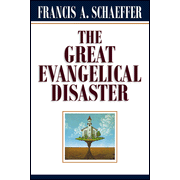
The Great Evangelical Disaster

The Last Apologetic
 

Francis Schaeffer’s most classic work is a call to the Evangelical church of it’s need to remain biblical, and is just as important reading for the Christian today as it was when the book was first published in 1984. Schaeffer’s message is that with the Reformation many came to Christ with the absolutes based on biblical form found in the bible, and it became widely known and great freedom came out of that. But in  the early part of the 20th century - that Freedom became Autonomous, self-directed, and self-governing, and over time biblical form and the Christian consensus lacked constraint.


In explaining the moral breakdown of our times, Francis Schaeffer says this; “The titanic freedoms which we once enjoyed have been cut loose from their Christian restraints and are becoming a force of destruction leading to chaos. And when this happens, there really are very few alternatives. All morality becomes relative, law becomes arbitrary, and society moves towards disintegration. In personal and social life, compassion is swallowed up by self-interest…“When the memory of the Christian consensus which gave us freedom within the biblical form is increasingly forgotten, a manipulating authoritarianism will tend to fill the vacuum. At this point the words ‘right’ and ‘left’ will make little difference. They are only two roads to the same end, the results are the same. An elite, authoritarianism as such, will gradually force form on society so that it will not go into chaos-and most people would accept it.” (pg 23)
 

The distinctly Christian position of Knowledge, moral and spiritual truths of God’s word were being compromised in the church, and accommodation to the world’s thinking gave way to the spirit of the age, as liberal theology entered the Church, while notable scholars such as J. Gresham Machen who stood firm in the battle for biblical truth and biblical inerrancy were being silenced and driven out. It comes down to this; are we obeying the scriptures? Because this is the real test of our faith and lives in Christ and rather we believe the bible. This is not just a theological debate, but practical and obedient living.
 
Schaeffer reminds us again that “the whole world is under the control of the evil one” 1 John 5:13), and that Christians seem to have forgotten this, and spend little time considering this in relation to our daily lives in this world and how this relates to the culture’s effect on our church teaching and doctrine and urges the reader to stand firm on God’s Word and not succumb to the temptation of compromise and accommodation of worldly thinking.


Dr. Francis A. Schaeffer is widely recognized as one of the most influential Christian thinkers of our day. He wrote over 23 books which were translated into 25 languages and have sold over 3 million copies. Schaeffer’s most influential books include: A Christian Manifesto, The God Who Is There, Escape from Reason, He Is There and He Is Not Silent, and Whatever happened to the Human Race? Dr. Schaeffer and his wife Edith founded L’Abri Fellowship, an international study center and Christian community with branches in Switzerland, England, the Netherlands, Sweden, France, and the United States. He lectured frequently at leading universities in the U.S. and abroad. His common theme is the uncompromising truth of historic, biblical Christianity and its relevance for all of life.

Copyright © 1984 Francis A. Schaeffer
Publisher: Crossway Books & Bibles
ISBN: 0891073086
ISBN-13: 9780891073086

Reading / Review Date: February 20, 2009


Video:  Francis A. Schaeffer - A Christian Manifesto  


Wednesday, July 6, 2011

Quitting Church

The Author attempts to explain why so many Christians still remain faithful yet dissatisfied and disconnected from the established church. The case histories of those included in the book were insightful, poignant and revealing. Julia Duin explores factors that are causing a shift in why people are leaving churches. The data is impressive. She delves into trends and fads like: house-churches, emergent congregations and postmodernism. This book is not convincing when it presented these options as opposed to traditional churches.

In her statistical data she shows how 78 million protestants don’t go to church, and states in her research that people are simply not being pastured. She writes about her own experience of being churchless and her struggle to find a church from her Charismatic background. Unfortunately she endorses charismatic- extremist teachers from the signs and wonders movement as good models in the book, which we didn’t find helpful.

Her conclusions and remedy for the problems given at the end of the book--she suggests going back to the ’covenant community movement’ like in the 70’s, to which she was a part of. She writes favorably of the house-church movement. This isn’t the best answer for the situation, especially from what has already been well-documented of the past record of the (Shepherding discipleship Movement) blunders and abuses that occurred in the 70‘s and 80‘s, and still would be troublesome today if it’s practices were repeated in today’s church. Two such books that document these movements are ‘Drift into Deception’, and also see the book ‘Damaged Disciples’).

Copyright © 2009
Publisher Baker Books  
ISBN: 0801072271

Reading / Review Date: January 2009

Tuesday, July 5, 2011

Christless Christianity


The Author communicates what he believes is the problem that is diminishing Christ from His prominent place in the Church, and in the heart and minds of Christians. One concern that he writes about is ‘Moralistic Therapeutic Deism’ in it’s various forms being promoted and practiced within the Church.


Michael Horton says: “My aim is not to target any particular wing, movement, person, or group. We are all victims as well as accomplices in our captivity. In fact, my sense of urgency is motivated by my impression that ‘Christless Christianity’ is pervasive, crossing the conservative-liberal spectrum and all denominational lines.”

What really caught our attention on the reading of this book, was how it shows that humanistic thinking is really down playing what Christ did for us. It’s like Christianity is becoming a works-based approach to know God, and not that we are God’s creation, and desperately deprived and that God stepped in and rescues us at the Cross by what Jesus Christ did for us. This is the Good News that needs to be shared and proclaimed.

Some of the concerns Michael Horton raises is how the Church in America is obsessed with being successful and relevant, and is mirroring the world without holding to the scriptures instruction to be holy and set apart unto God. He writes: “The church has repackaged itself that it can satisfy the masses. The church has become similar to many secular programs and self-help groups, becoming shallow and human centered.”
 

The author covers many of the current efforts of the Church’s use of programs and methods to recapture people’s hearts for God, and shows how these attempts have done little to bring Christians back to centering their focus on Christ and his finished work of redemption. The Author also discusses current popular authors and Evangelical teachers that are using psychology and new age teachings that distort the meaning of the Christian Faith. He is descriptive and thorough in his explanations of why this raises concerns.

Michael Horton shows how these methods and programs cause the Christian to be distracted from the simplicity of Christ. Paul warned us from the Bible to be on guard against such things: 2 Cor. 11:3 “But I am afraid that , as the serpent deceived Eve by his craftiness, your minds will be lead astray from the simplicity and purity of devotion to Christ.”

 Some notable statements Horton addresses in the book deserve thoughtful reflection by Christians: On page 19) “The bible is mined for ‘relevant’ quotes but is largely irrelevant on it’s own terms; God is used as a personal resource rather then known, worshipped, and trusted; Jesus Christ is a coach with a good game plan for our victory rather than ‘Savior’.

On page 24) The Author asks the questions; “Does Christ come merely to improve our existence…Is Christianity all about spiritual and moral makeovers or about death and resurrection?…Is the Word of God a resource for what we have already decided we want and need, or is it God’s living active criticism of our religion, morality, and pious experience? In other words, is the Bible God’s story, centering on Christ redeeming work that rewrites our stories, or is it something we use to make our stories a little more exciting and interesting?

There was a good section in the book where the author shows how some people use the bible subjectively and allegorically which leads to misunderstanding of the scriptures.

Copyright © 2008 Michael Horton
Publisher: Baker Books
ISBN: 0801013186
ISBN-13: 9780801013188

Reading / Review Date: January 2009

 
The Author Michael Horton speaks about his book


Thursday, June 23, 2011

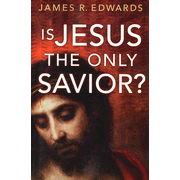
Jesus the only Savior?

Is Jesus the Only Savior?

Christianbook.com
A book rich in theology that will give clear answers for why Christianity is exclusive in it’s truth claims and proofs of why Christ is the only Savior. The author sets forth his discussion giving examples of how Jesus is viewed by contemporary culture. He takes on difficult issues like religious pluralism, postmodernism, and relativism.


The author James R. Edwards digs deep into scripture and gives historical background and evidence to reveal to the reader the nature and character of God and how there is no conflict in the presentation of the gospel and the exclusive claim of why Christ is the Redeemer of mankind and the only Savior of the world as Acts 4:12 clearly states, “And there is salvation in no one else, for there is no other name under heaven that has been given among men by which we must be saved.”


Copyright © 2005
ISBN - 0802809812

Reading / Review Date: August 2008


Tuesday, June 21, 2011

Driven Away by Purpose

An Examination Worth Reading

 This book is an examination of the purpose-driven life book, and also the 40 days of purpose and Rick Warren’s Peace Plan. The book also evaluates Richard Abanes 2005 book which was a defense of Rick Warren’s PDL church model, and it’s books and programs against it’s Critics. The Author of this book writes from his own experience of seeing the consequences of the Purpose-driven life movement within his own church in Singapore. Daniel Chew shows how the PDL teachings compromises the purity of doctrinal truth and in many cases is a False Gospel.

This Author takes a thorough examination of the PDL’s use of poor translations and in some cases mistranslations of the verses used in the Purpose-Driven Life book Warren uses to support points in his book. Evidence is given to show that Warren’s uses of Paraphrase Bible verses leads to a misunderstanding of the true intent of the verse and can distort a person’s understanding of Scripture. This book effectively shows that methods really can change the message and can be harmful.

One area that is most disturbing is PDL’s giving of the Gospel. Chew sites entries from the PDL book. The emphasis is on “Invitation” rather then a turning from and repentance of sin. The brokenness and godly sorrow that leads to Salvation (2 Cor. 7:10) is missing from repentance. PDL’s invitation is something less then the gospel requires. With this being the case the Author shows an example hypothetically of how a New Ager could still pray Warren’s prayer and still remain a New Ager.

One out of several important aspects the Author examines is: Warren’s denigration of doctrine and how his PDL church model elevates Unity above Truth. Daniel Chew quotes from the PDL book in making his points clear. He shows how there is an overemphasis on unity and relationships in promoting a protection of Warren’s Church model, and the purpose-driven life definition of “unity” is not the biblical definition of unity mentioned in the Bible. The PDL model of church does not allow disagreement centered on doctrine or discernment and leadership. In the PDL Church model - “Unity” becomes Militant and can be confrontational and truth is disregarded in the process. Compromise of the Faith becomes inevitable. We’ve read other books assessing the PDL movement, this book takes a much different approach showing the theological position within the purpose-driven movement.

Copyright © 2006 by Daniel HC Chew
Publisher: Xulon press
ISBN - 1-60034-618-9
Can be purchased at Amazon.com

Reading / Review Date: March 23, 2008

Monday, June 13, 2011

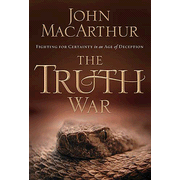
The Truth War

Fighting for Certainty in an Age of Deception

Dr. John MacArthur takes a bold and straight forward approach to addressing the current trends that have been invading the Church. He gives clear, well defined definitions of the Emerging and Emergent church movements and other trends such as the purpose-driven movement that have been moving through the Church. The author outlines in each chapter his scriptural reasons for his deep concerns.

MacArthur warns that: ‘Trends signal a significant departure from biblical & historic Christianity’. MacArthur shows examples of points in early church history where the fight for Truth is what keeps the purity of our Faith intact. A key concern for the church is Apostasy to which 2 Thess 2:10 warns will happen to those who do not receive the love of the truth.

This book takes a closer examination of these current trends in the Church and quotes what the Leaders of these movements say themselves, it is quickly apparent that historical Christian truth is being undermined. We are being told by some of these leaders that ‘Truth found in Scripture’ can’t be certain or knowable. As the author writes; ‘Truth is under assault in the Church today’, and ‘People are experimenting with subjective, relativistic ideas of Truth and labeling them Christian’. But contrary to popular teachings and thought, stands the enduring truth of scripture. 2 Tim 3:16,17, Psalms 119:160, Proverbs 30:5, 1 Peter 1:25

Another important point addressed in this book is the Christian’s apathy towards discernment and the Church allowing false teachings to flourish, and the sad lack of duty to contend earnestly for the Faith - Jude 3. John MacArthur writes that church leaders are especially responsible for setting the example for all believers - Jerm 3:15, Acts 20:18-31.


The Truth War - Fighting For Certainty in an Age of Deception
John MacArthur 


“The Truth War” will cause you to really think about your faith, what you believe and why. You will learn important lessons on discernment and how to determine truth by applying the Scriptures, and you will grow in your knowledge of Christ. For those who already hold to sound doctrine, it will refresh you. Recommended Reading.

John MacArthur is the author of over 150 books including many best-sellers. He is the Pastor-teacher of Grace Community Church in Sun Valley, California and President of the Master’s College and Seminary. He is also president of  Grace to you  ministries which produces an internationally syndicated radio program, along with print, audio and internet resources. http://www.gty.org/Resources

Copyright © 2007 John MacArthur
Thomas Nelson publishers - http://www.thomasnelson.com/consumer/
ISBN - 10: 0-7852-6263-6


Reading / Review Date: July 14, 2007


Monday, May 30, 2011

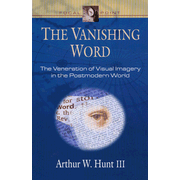
The Vanishing Word

The Vanishing Word - The Veneration of Visual Imagery in the Postmodern World - Arthur W. Hunt III  

 In our technologically advanced age the value of the written word is being lost. Arthur W. Hunt III reveals that we have entered a high-tech version of the Dark Ages, but he admits he is not the first to do so. He shows how the Judeo-Christian heritage is characteristically word-dependent, and contrasts this with Paganism, which typically has been image-dependent. The book shows how the Dark Ages of Europe illustrate what can happen when a culture lapses from the written word, and that image has supplanted the word, causing pagan forms to return.

The Bible calls Babylon “the great whore that sitteth upon many waters: with whom the kings of the earth have committed fornication” Revelation 17:1,2. Spiritually, Babylon is the relentless competitor of revealed religion and strives to change the truth of God into a lie, by idolizing the creature over the Creator (Romans 1:25). The term mystery Babylon is allegorical for the political religious systems of ancient Egypt, Canaan, Assyria, Greece, and Rome all of which bowed to the image.

The Author shows the reader examples of this by giving a historical account of how this is leading our present society into Idolatry and Paganism. The devaluation of the written word is leaving people defenseless against counterfeits and leaves them open for whatever trend comes along. This book takes a close examination of our media saturated culture.

This book is a clear warning that the church is being cut off from its word-based heritage. We are open to abuse by those who exploit the image but neglect the Word. Thoughtful readers will find this a challenging call to be critical about the images bombarding our senses and to affirm that “the Word is everything.”

© 2003
Published by Crossway Books   http://www.crossway.org/   
The Vanishing Word - Arthur W. Hunt III
ISBN 1-58134-404-X
Christianbook.com: The Vanishing Word

Review Date: June 2006